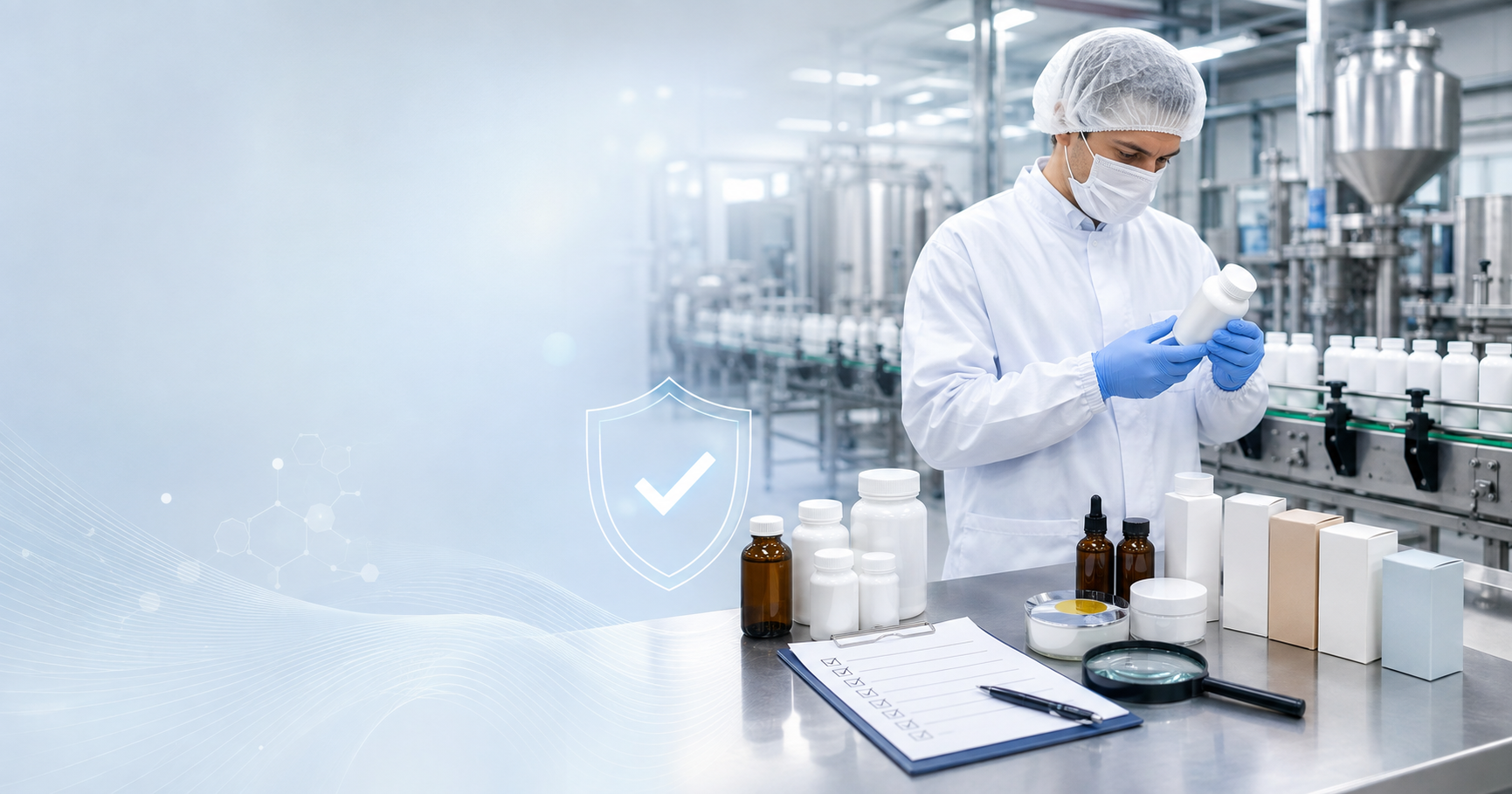
What Should You Look for When Choosing a Reliable Manufacturer?
If you want to launch products under your own brand, one of the most important steps in a successful contract manufacturing process is choosing the right manufacturing partner. From formulation and raw material selection to production, filling, and packaging, every stage directly affects product quality and brand reputation.
Especially in areas such as contract food manufacturing, contract supplement manufacturing, and contract cosmetics manufacturing, offering a competitive price alone is not enough. Production must be carried out in line with appropriate quality standards, processes should be properly documented, and products should go through the necessary quality controls.
So, what are the main quality standards in contract manufacturing, and what should you consider when choosing a manufacturer?
What Is Contract Manufacturing?
Contract manufacturing is a business model in which a brand outsources production to a qualified manufacturer instead of establishing and operating its own production facility.
This model allows businesses and entrepreneurs to:
- Develop products without building their own factory,
- Enter the market without major equipment investments,
- Benefit from professional manufacturing infrastructure,
- Launch different product categories under their own brand,
- Manage production, filling, and packaging processes more efficiently.
However, to benefit from these advantages, the selected manufacturer must have strong quality control and production management systems.
Why Is Quality Important in Contract Manufacturing?
Even if your products are manufactured by another company, your brand name appears on the final product.
This means that every quality issue directly affects your brand reputation.
A small production problem may lead to:
- Differences between production batches,
- Shorter-than-expected shelf life,
- Filling or packaging problems,
- Customer complaints,
- Product recalls or reproduction,
- Loss of customer trust.
For this reason, a professional contract manufacturer should not simply manufacture the product. The company should control the entire process, from raw material intake to the finished product.
1. Raw Material Quality and Supplier Control
High-quality products begin with high-quality raw materials.
Raw materials used in contract manufacturing should be sourced from reliable and traceable suppliers whenever possible. Manufacturers should evaluate incoming materials according to their technical specifications and review relevant analysis reports or certificates when required.
Raw material standardization is particularly important for:
dietary supplements, herbal products, vitamin and mineral products, cosmetics, and naturally derived formulations.
Two raw materials sold under the same name may differ significantly in terms of purity, active ingredient concentration, density, or technical characteristics.
Therefore, professional manufacturing is not only about which ingredient is used, but also about the quality and specification of that ingredient.
2. Hygiene Standards in Production Areas
One of the key factors when selecting a contract manufacturing facility is the hygiene standard of the production environment.
Production areas should be designed according to the relevant product category, equipment should be cleaned regularly, and manufacturing should take place under controlled conditions.
Important factors include:
- Personnel hygiene,
- Equipment cleaning,
- Production area sanitation,
- Separation of raw materials and finished products,
- Cross-contamination controls,
- Appropriate storage conditions.
In food and dietary supplement manufacturing, quality systems such as HACCP and GMP can be especially important depending on the product category and applicable regulations.
3. Accurate and Repeatable Formulations
One of the most important requirements in contract manufacturing is batch-to-batch consistency.
A product manufactured today should have the same expected characteristics when produced again several months later.
To achieve this, manufacturers should properly document and control:
- Formulations,
- Raw material quantities,
- Production sequence,
- Mixing times,
- Processing temperatures,
- Filling quantities,
- Critical production parameters.
Professional manufacturing is not simply about developing a successful formula once. It is about being able to reproduce the same product consistently at the same quality level.
4. Quality Control During Production
Quality control should not be limited to the final stage of production.
Checking the product during different production stages makes it possible to identify potential problems before the process is completed.
Depending on the product category, quality checks may include:
- Appearance,
- Color,
- Odor,
- Homogeneity,
- pH,
- Density,
- Filling weight or volume,
- Packaging compatibility.
When necessary, additional laboratory analyses may also be required.
For dietary supplements in particular, ingredient specifications, product composition, and technical documentation should be carefully prepared and controlled.
5. Batch and Lot Traceability
Every production batch should be traceable.
A proper batch or lot tracking system allows the manufacturer to review important information if a problem occurs.
This may include:
- Which raw materials were used,
- When the product was manufactured,
- Which production records belong to the batch,
- Which packaging materials were used.
Traceability is essential for both quality management and long-term brand protection.
6. Filling and Packaging Quality
Even a high-quality formulation may lose customer trust if it is poorly filled or packaged.
For this reason, contract filling and packaging services are an important part of the manufacturing process.
Bottles, jars, tubes, boxes, sachets, and other packaging components should be suitable for the product.
It is also important to maintain:
- Consistent filling quantities,
- Proper sealing,
- Correct cap application,
- Accurate labeling,
- Professional packaging appearance.
The right packaging also helps protect the product during transportation, storage, and throughout its shelf life.
7. Regulatory Compliance
When choosing a contract manufacturer, production capacity should not be the only consideration.
The manufacturer should also understand the regulatory requirements of the relevant product category.
This is important because the rules for:
food products, dietary supplements, and cosmetic products are not the same.
Each category may involve different manufacturing requirements, documentation, product notifications, approvals, labeling rules, and technical files.
For companies launching their own brand for the first time, working with a manufacturer familiar with these processes can provide a significant advantage.
A good manufacturing partner should support not only production but also the overall product development and market preparation process.
8. Sampling and Product Development
Another important advantage of professional contract manufacturing is the ability to develop and evaluate samples before mass production.
Instead of moving directly into large-scale production, it is often more effective to begin with product samples or pilot batches.
During this stage, brands can evaluate:
- Product texture,
- Ingredient profile,
- Taste or aroma,
- Viscosity,
- User experience,
- Packaging compatibility.
Necessary revisions can then be made before mass production begins.
This approach reduces unnecessary production costs and makes it easier to develop a product that matches the brand's expectations.
How Should You Choose the Right Contract Manufacturer?
When searching for a manufacturer for your brand, focusing only on the question “What is the unit price?” may lead to poor decisions.
Before choosing a manufacturer, consider asking:
Which product categories does the facility manufacture?
How are quality control processes managed?
How are raw materials selected and approved?
Does the company provide product development and sampling support?
Are filling and packaging services available?
Which packaging options are supported?
What are the minimum order quantities?
Does the company offer private label manufacturing?
Can the manufacturer support regulatory and documentation processes?
A manufacturer that can provide clear answers to these questions can make your production process considerably easier.
Contract Manufacturing for Food, Supplements, and Cosmetics
Contract manufacturing can be used across many different product categories.
Contract Food Manufacturing
Honey and bee products, syrups, herbal blends, and various food products can be developed and packaged under your own brand.
Contract Dietary Supplement Manufacturing
Custom formulations can be developed in different formats such as:
- Tablets,
- Capsules,
- Liquids,
- Syrups,
- Drops,
- Lozenges,
- Other supplement formats.
Depending on the market where the product will be sold, relevant regulatory and product approval requirements should also be considered.
Contract Cosmetics Manufacturing
Custom-branded cosmetic products can include:
- Creams,
- Gels,
- Shampoos,
- Soaps,
- Serums,
- Personal care products.
These products can be formulated, manufactured, filled, labeled, and packaged according to the brand's requirements.
Because every product category has different production needs, it is important to work with a contract manufacturer that has the appropriate infrastructure for your specific product.
Quality Contract Manufacturing Builds Stronger Brands
Launching a successful product involves much more than having a good idea.
A reliable production process requires:
the right formulation, high-quality raw materials, controlled manufacturing, appropriate packaging, and consistent quality control.
Whether you are creating a new brand or expanding an existing product portfolio, the right contract manufacturing partner can make the product development process faster, more efficient, and more reliable.
Want to Manufacture Products Under Your Own Brand?
If you have a product idea for your brand, you do not have to manage every production detail on your own.
You can explore suitable solutions for:
product development, contract manufacturing, filling, packaging, and private label production.
Whether you are planning a food product, dietary supplement, or cosmetic product, the production process can be structured according to your product idea, target quantity, formulation, and packaging requirements.
Contact us to discuss your product idea and discover suitable contract manufacturing solutions for your brand.
Let us evaluate the right production model for your project together.